WeCycle
Client
WeCycle
Services
UX Research, UX Design, Mobile Design
Timeline
2 months
Year
2023
Project Overview
Create a community of people centered around this purpose: connecting with others to swap clothing items so your old clothes can find a new home while you get some new styles in a sustainable, free, and environmentally conscious way.
Motivation
Everyone has clothes in their closet they never wear. For many, simply selling or returning these clothes may not be an option, whether the clothes aren’t worth selling or they prefer a more sustainable way to come by fashion. Whatever the reason, finding a new use for these clothes can be a struggle.
Research
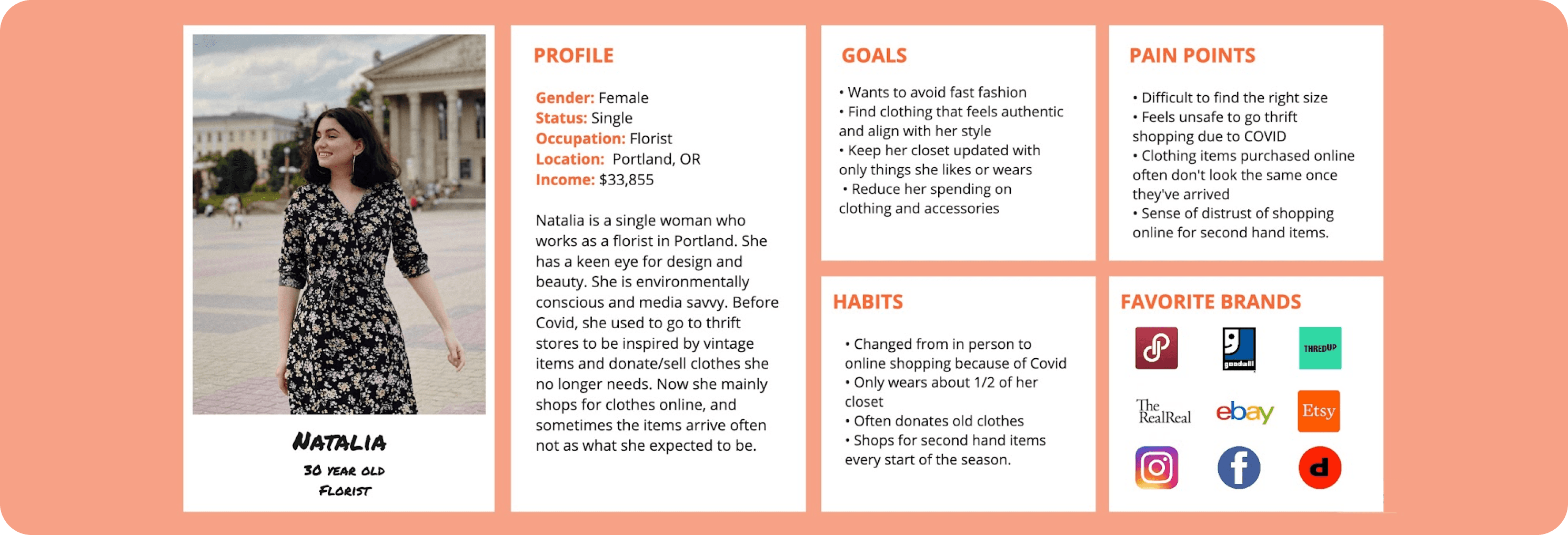
I initiated the research phase of this project wanting to understand what's really going on with people's wardrobes. How do they find new clothes? What do they do with clothes they want to get rid of? Are they actually even wearing the clothes they have in their closets? Through a series of interviews and surveys I discovered, among other things, that 70% of people said they wear less than half of the clothing items in their closet. That's a lot of clothing just sitting around waiting to be worn.
Two other key metrics I'd highlight are: 75% have gotten at least some of their clothing from thrift stores and 75% cited the environment and an aversion to fast fashion as drivers toward thrifting. In summary, there are a lot of people with clothes they don't wear that are also completely open to finding new clothes secondhand.
Leveraging the output of my research, I created the User Persona above. The Persona, Natalia, represents a young professional who is operating on a budget. She always loves to find new styles, especially vintage and secondhand, but is also conscious of fast fashion and her wallet. The question becomes: how might we create a trustworthy online experience that allows Natalia to find secondhand clothing that meets all her criteria?
2. Ideation
I transitioned into the Ideation phase by conducting a Competitor Analysis. I assessed the digital presence of thrift and secondhand shopping forums like Poshmark and Goodwill. I even looked at the Instagram Shop feature and Facebook Marketplace. I documented each of their pros and cons and started to get a picture of what kind of features would and would not meet the needs of our Persona and her problem statement.
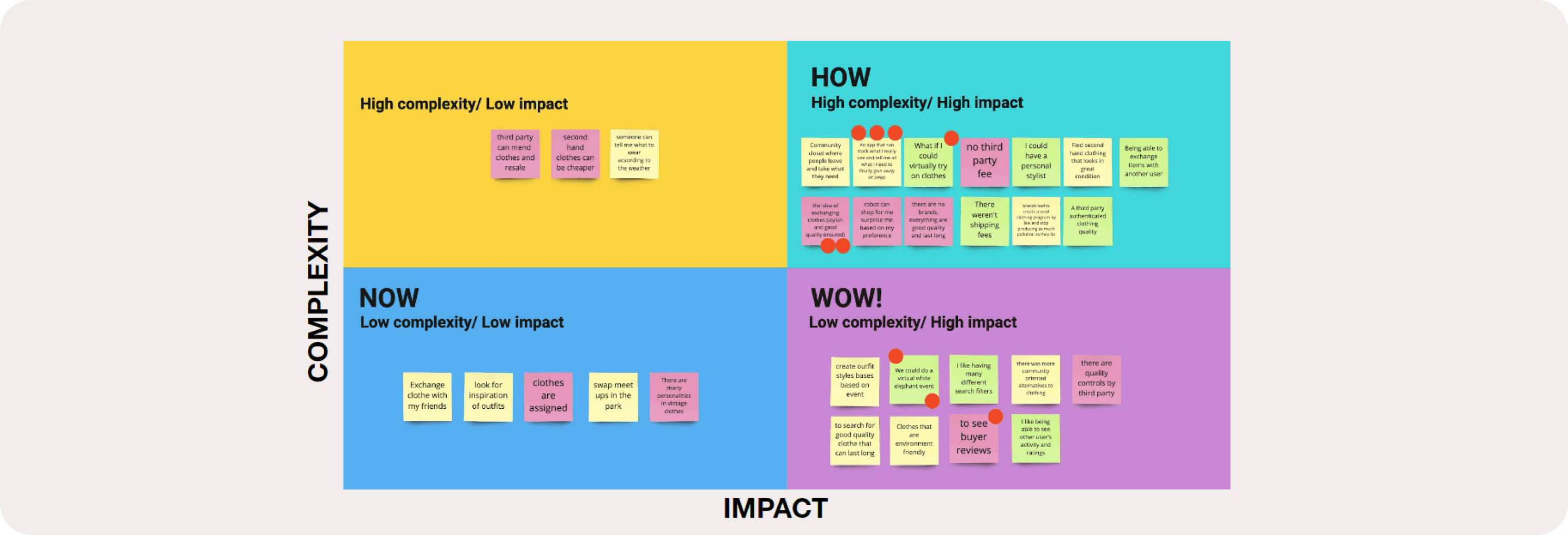
I compiled the relevant features and ranked them based on their complexity to implement and the potential value they would provide to a user, creating the Feature Prioritization Matrix pictured above. I ultimately landed on a mobile app that's primary function would be swapping clothing with others. Based on my research, I knew it would be important the app also included a number of features enabling users to validate the quality, fit, and style of the clothing they would be receiving.
I narrowed the initial list of features down to several key workflows I wanted to focus on for MVP. These workflows are: user onboarding, the browsing and filter experience, and finally the virtual try-on and swap request.
3. Prototyping
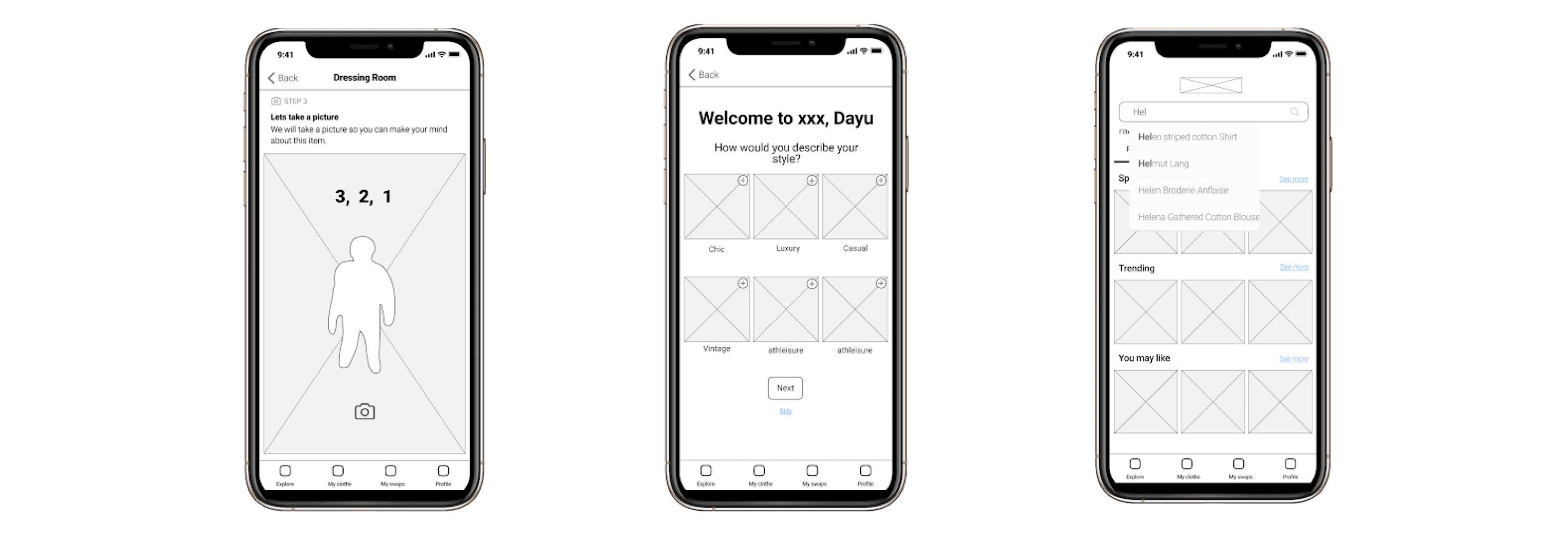
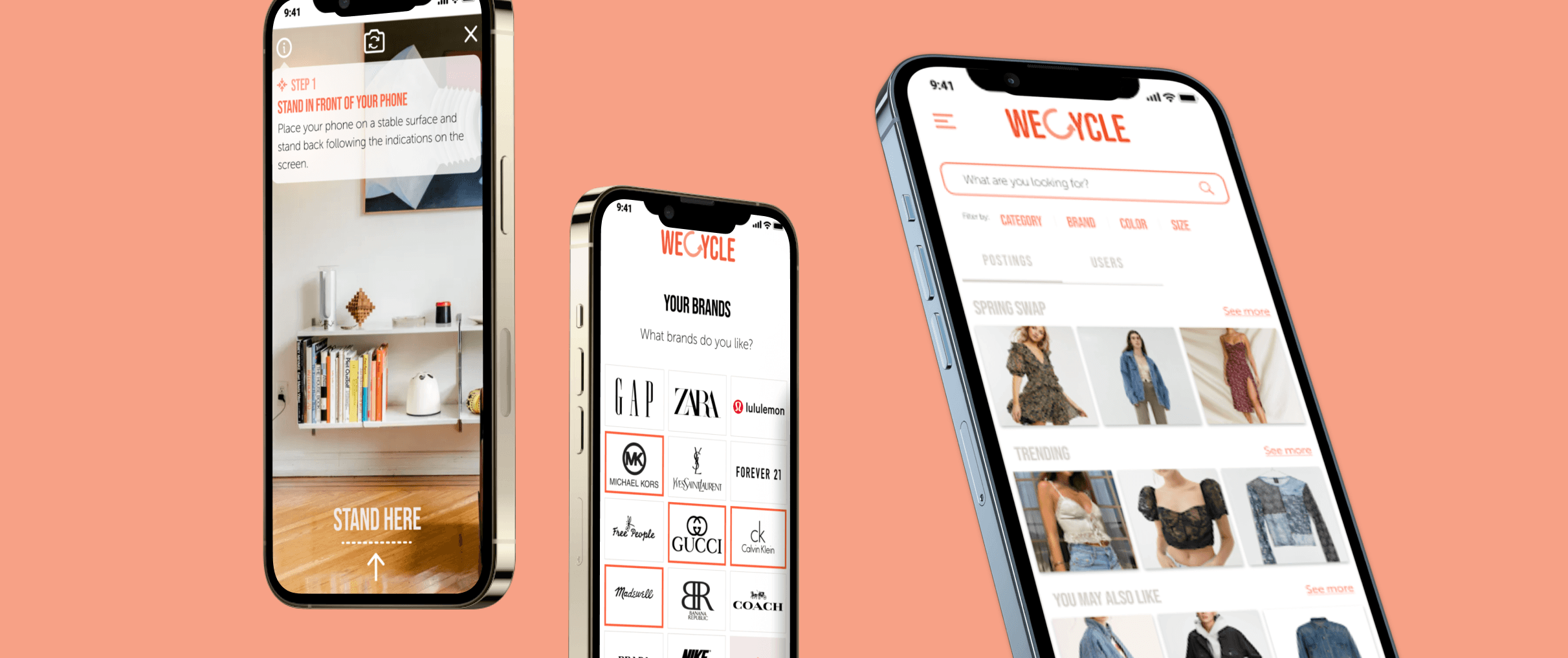
I used Figma to begin building a low-fidelity prototype. The prototype initially focused on the three key workflows mentioned above, the first of which was onboarding. The onboarding process has users set up their account including their clothing preferences. Users are asked to describe their style and identify some of their favorites brands. This process is intended to curate how users discover available clothing that might be most relevant to them.
The second workflow included the search and filter functionalities. Matching available clothing to their personal style is essential to users, so ensuring a robust searching system is a cornerstone of WeCycle's mission. Users are given the ability to filter by a number of fields like specific brands or sizes. Results would then appear by relevancy based on the user’s selected preferences with the option to sort by other criteria.
The third workflow incorporated an AR dressing room and the actual request to another user to swap clothing. After finding an article of clothing they liked, users would have the option to virtually 'try on' the item using their phone's camera and a built-in AR feature. If they liked the way it looked, they could request the item owner to swap, offering up an item of their own to exchange or allowing them to choose something from their listed items.
4. Testing & Iteration
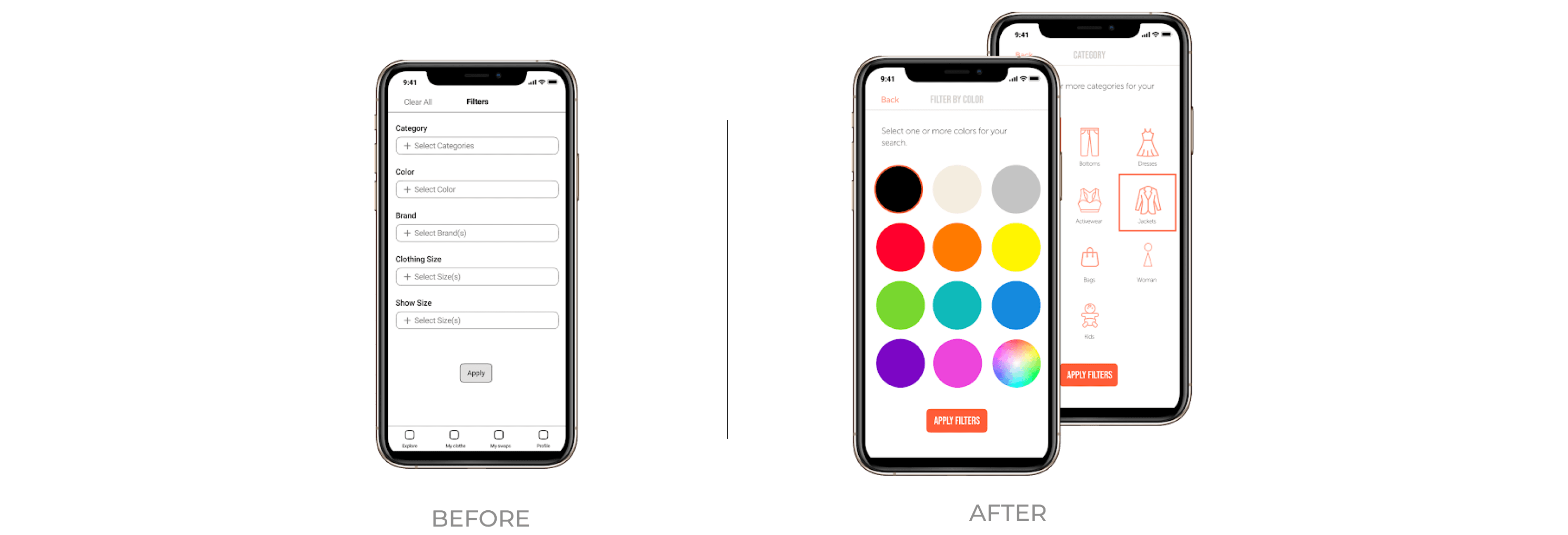
Once I completed the low-fidelity prototype, I organized an initial round of testing with several users. I asked the users to complete specific tasks and observed their actions as the navigated the prototype, documenting moments they struggled with or identified as unintuitive.
The filter and search functions, in particular, received recommendations to add the ability to filter by multiple conditions simultaneously and to add new filter options to improve the precision of results. Testing also contributed to several improvements to the menu and navigation. Namely, I removed the menu from the onboarding process as it was not necessary at that point in the user's journey and reconfigured it from a bottom-aligned navigation bar to a consolidated hamburger menu at the top left to reclaim screen real estate.
I incorporated these with other changes as I began work on the high-fidelity version of the prototype. The new iteration included implementation of my style guide's colors, fonts, and iconography along with the usability improvements identified in testing. Once complete, I conducted another round of testing using my high-fidelity prototype to further iterate the app.
5. Results & Takeaways
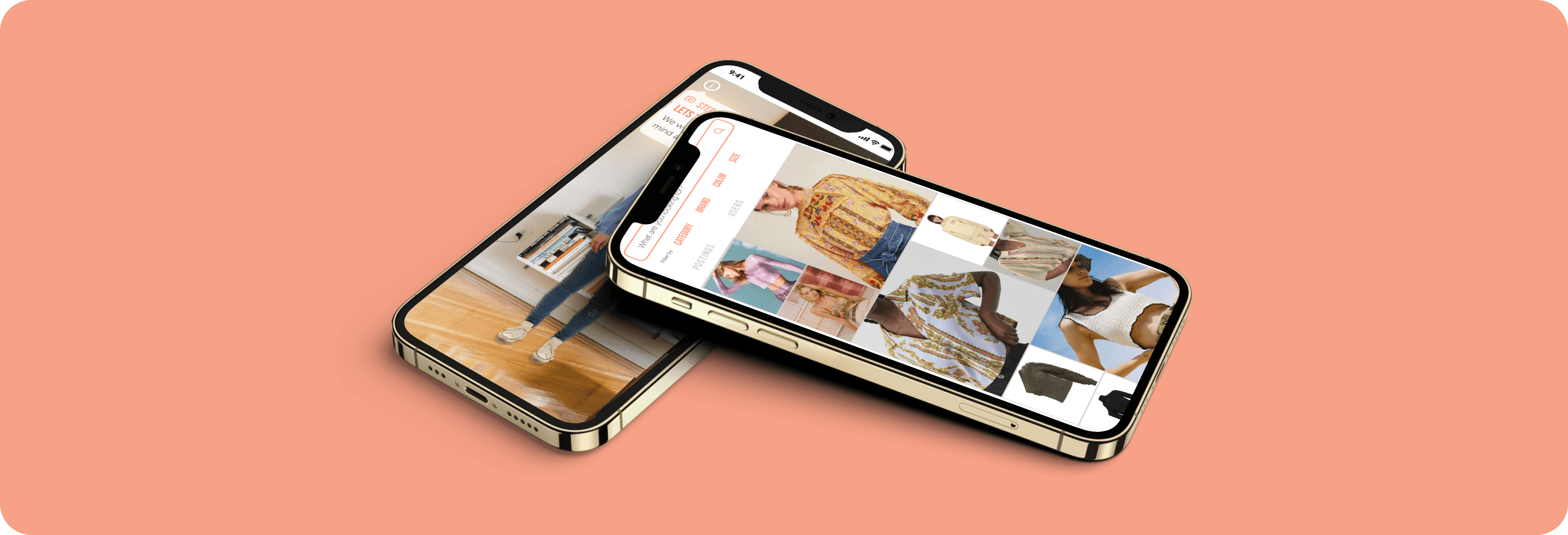
Focusing only on the three key workflows I mentioned, there are more features I would want to design for WeCycle. First, l would want to fully build out the end-to-end experience of the existing workflows. For example, designing the swap request from the perspective of a user receiving request is essential to optimizing the way this activity flows. There are also net new features and screens that I would like to design, like a My Closet, a profile showing all currently listed clothes users have made available to swap.
The features in my backlog all drive toward the central goal of creating a community that is as robust as possible, allowing users to find items and styles they love in the most efficient way.